When I was a young teenager, I rolled my eyes at my mother’s paintings. Quietly. I wasn’t a monster.
She painted in oils, and she painted a lot. Sailing ships, lighthouses, still lifes, and they hung on just about every wall of the house. To me they looked hopelessly old-fashioned, like something you’d find in a waiting room nobody had redecorated since Eisenhower.
Then I went to art school, which didn’t help. Now I had a degree and the vocabulary to point out exactly where the perspective wandered off. I could see every imperfection, and I noticed all of them.
Mom passed away five years ago. My brother and I didn’t clear out her house until two years ago, and that’s when it happened. Somewhere between the packing tape and the piles, I looked at those paintings and fell in love with them.
What I’d missed all those years was simple. She was completely self-taught. Nobody showed her how to paint water or light. She worked it out on her own, canvas after canvas, and I paid tuition to learn what she taught herself.
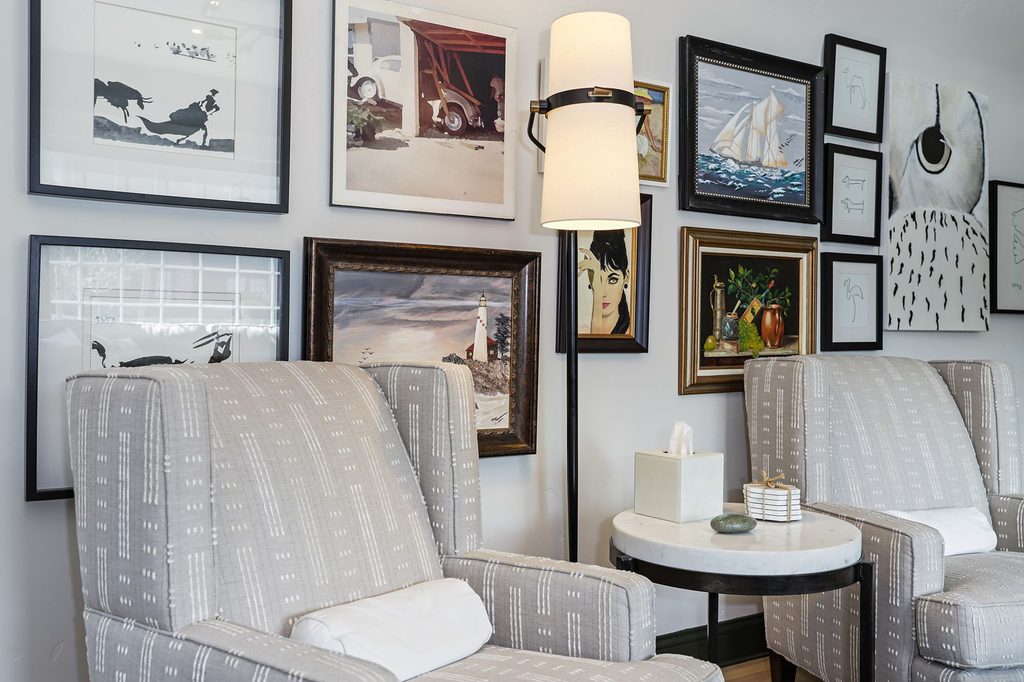
Her paintings now hang on a gallery wall in my living room, mixed in with art I’ve made and pieces I’ve collected over the years. They keep showing me things I never saw before. The tiny birds flying above the sailing ship. The sun breaking through the clouds behind the lighthouse. The marble ledge in her still life, painted in so much detail I want to reach out and touch it.
So yes, I’m an interior designer who got schooled by her mother’s paintings. It changed how I think about decorating with family heirlooms, for my own house and for every client who calls me with a garage full of a parent’s things.
Inherited doesn’t mean obligated
When a family’s things land in your lap, it can feel like you’ve been handed homework. Keep everything and feel crowded. Get rid of it and feel guilty. Most people pick option three, which is putting it all in a storage unit and not talking about it.
Here’s the problem with a whole house of inherited stuff. When it’s all in one pile, it all looks like old stuff. The treasure is in there. You just can’t see it yet.
I see it happen on project after project. We spot something the homeowner has walked past for years, pull it out, and give it a proper place in a collection or a display. Then the homeowner stands back and can’t believe it’s the same piece.
So here’s my one rule, and I’m firm about it. Don’t get rid of anything until we’ve looked it over. After that, keep the pieces you love and the ones with a story you’d actually tell a guest. Let the rest go to someone who wants them. There’s always a cousin who’s been eyeing that hutch for twenty years.
How to decorate with family heirlooms so they look like they belong
Edit before you hang
A collected home is an edited one. Twelve sentimental things on one shelf turn into noise, and nobody notices the one that matters. Decide which pieces lead the room, then give them some breathing space.
Feather in your own collection
This is the one people miss. An inherited collection doesn’t need its own shrine. My mom’s oils hang right alongside art I made and pieces I picked up along the way. Heavy gold frames sit next to skinny black ones, and there’s a lighthouse a few feet from a bullfight. The mix makes every piece look chosen, and the wall reads as my living room instead of a memorial to hers.
Gather what’s scattered
One candlestick on a shelf is a candlestick. Seven of them together are a collection. Things that look like clutter spread across a house can carry real weight once they’re grouped in one place.
Pair old with new
An antique doesn’t have to make the whole room feel old. Put a new painting above Grandma’s chest, or a modern lamp on a carved table, and both pieces look fresher for it.
Light what you love
Old canvases and dark wood go flat in a dim corner. A picture light, a lamp close by, or a fixture aimed at the wall brings out the brushwork and the grain. It’s cheap to plan before the electrician comes and annoying to fix after.
A whole house of keepsakes: the Bevilaqua project
The Bevilaquas came to us with treasured pieces from both sides of the family, plus a lifetime of things collected on their travels. None of it was the problem. Where it all lived was.
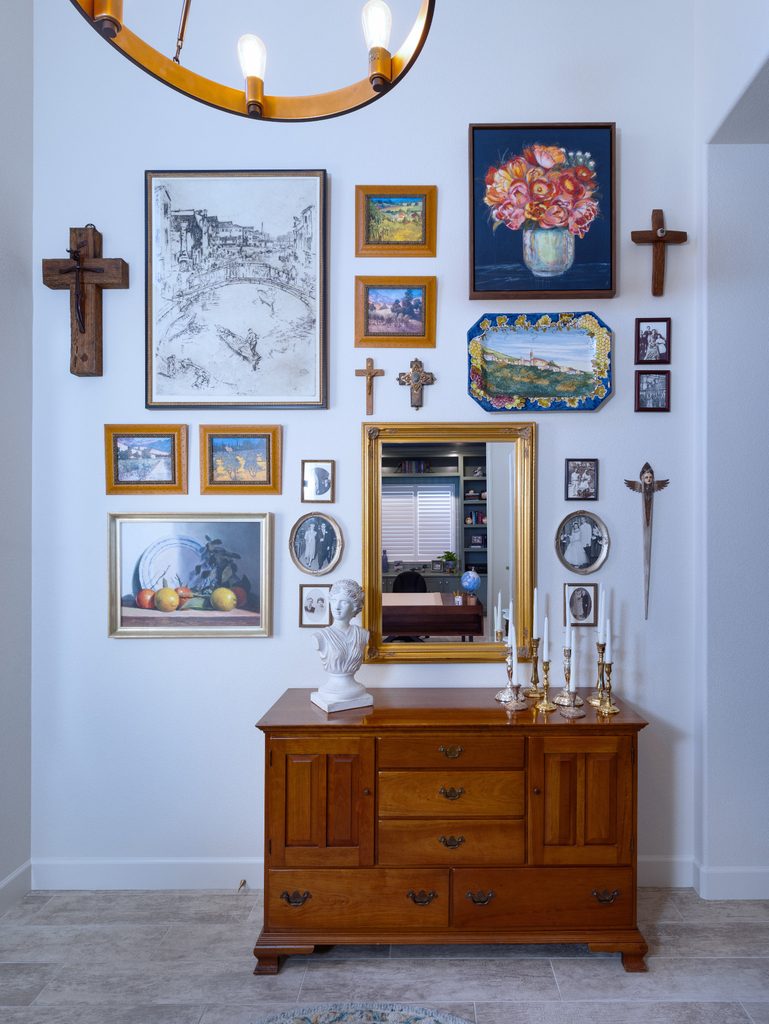
Take the crosses. Some came down from previous generations and some were picked up on trips, and they were scattered all over the house, one here, one there. We brought them together on the tall entry wall, around a gilded mirror and the family’s black-and-white wedding portraits. On their own they were easy to miss. Grouped together, they took on a whole new significance, and now they’re the first thing you see when you walk in.
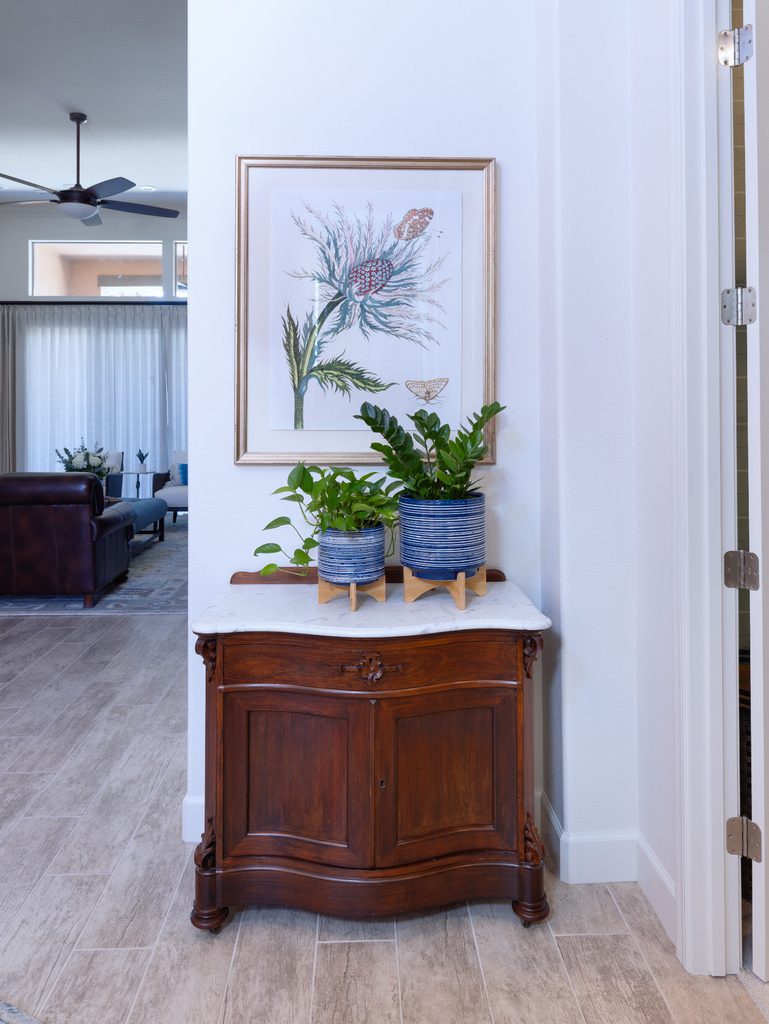
Then there was her grandmother’s chest. It was precious to her, and she had no idea where to put it. We put it front and center by the entrance and hung a new botanical painting above it. The chest keeps its history, and the painting keeps it from looking like a museum piece.
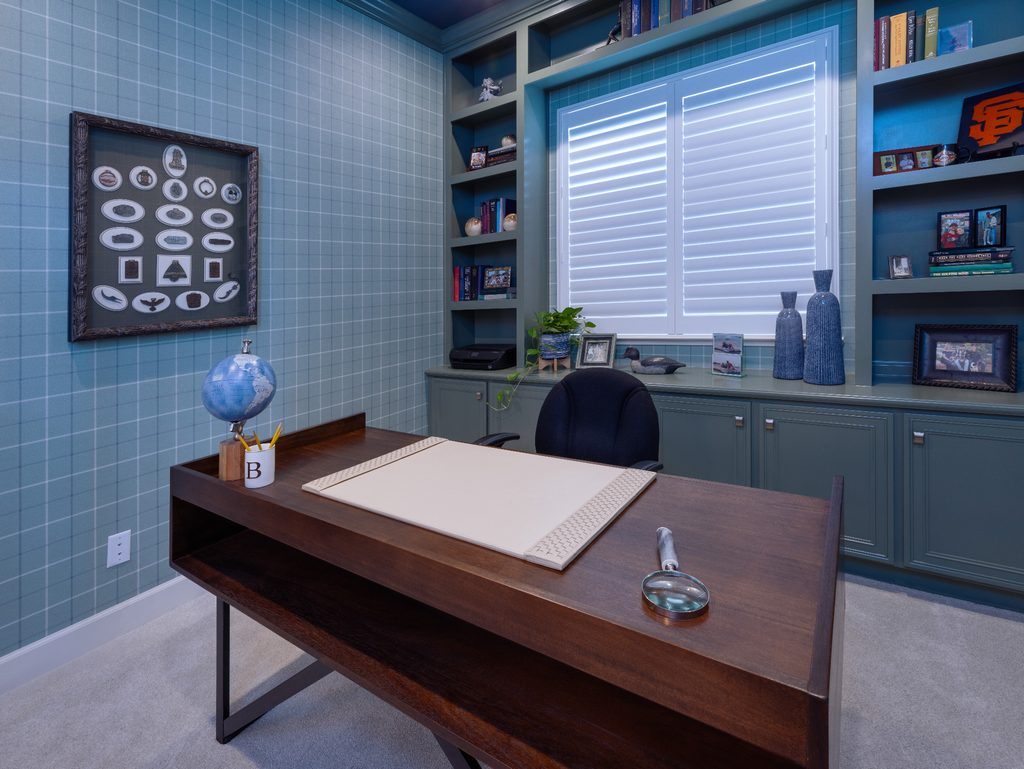
In the office, a shadow box holds Dave’s gold trophies from the famous golf courses he’s played. Trophies tucked in a drawer don’t tell anybody anything. Framed together on the wall, they tell the story of every course. The Giants stayed too. Some heirlooms are sacred.
What Italy taught me about layered rooms
When I traveled through Italy, what stuck with me was how layered everything felt. Stone stairs worn smooth over centuries. Apartments with family pieces sitting right next to modern furniture. Rooms that clearly grew over time instead of arriving in one delivery. You can tell when a house came from a single shopping cart, and you can tell when it holds an actual life.
I’m a firm believer in turnkey design, and people often assume that means sterile. It doesn’t have to. The best rooms I’ve designed are layered and finished at the same time. The family pieces have a place, the new pieces support them, and the house is ready to live in from day one.
Before you call the estate sale company
If you’ve inherited a houseful of furniture, art, and boxes you haven’t opened yet, call a designer first. On KTJ projects, we walk through what you have before anything leaves, and the pieces worth keeping get measured and drawn into the plan from the start.
KTJ Design Co. is a full-service interior design firm in Stockton, California, working with clients across the Central Valley and wine country. If you’re sitting on a house full of family history, start with a Design Consultation.
As for me, I’m still finding new birds.